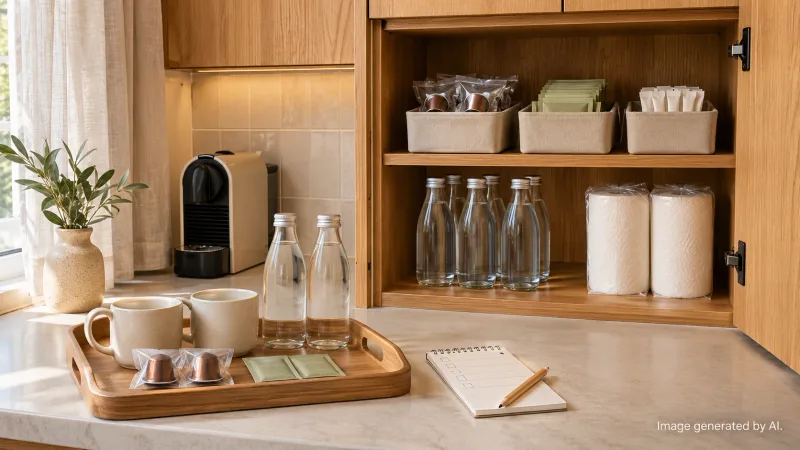
Guests do not review your purchasing process. They notice what they touch and use: toilet paper rolls in the bathroom, hand soap at the sink, coffee and tea in the kitchen, and paper products that make the first hours effortless.
In this guide, you will get a practical method for guest supply substitutions that keeps your agreed standard consistent across apartments - even when delivery delays, seasonal stock, or local logistics make your preferred products unavailable.
Why temporary substitutions fail
Most 1-star or “minor annoyance” reviews come from the same gap: supplies were restocked, but the experience shifted.
Temporary fixes turn into a pattern when:
- Different operators interpret the standard differently (size, fragrance, packaging, “good enough”).
- Substitutions happen during turnover, when time pressure reduces checks.
- Par levels are set for ideal conditions, not real lead times - especially during weekends.
- The team lacks a clear rule for what is allowed to change and what must stay identical.
To keep amenity consistency, treat guest supply substitutions like an operational process, not a last-minute decision.
Quick operator insight: If you ever received a complaint that “the coffee tastes different” or “the bathroom felt incomplete,” it usually signals a mismatch in presentation (variety, pack size, arrangement), not only brand preference.
SOPs and acceptance criteria: what to agree on
Start with SOPs (Standard Operating Procedures). Your SOP does not need to be long. It needs to be unambiguous - so that turnover stays consistent, even when you substitute.
In practice, agree on three layers:
- Room-set standard (what must be present every time): quantities per bathroom and kitchen, expected packaging type (e.g., roll vs pre-cut sheets), and guest-facing arrangement (where coffee/tea sits, how it is presented).
- Replacement triggers (when substitution rules activate): define “unavailable” (out of stock, delivery delayed past the turnover window, wrong item delivered, discontinued product).
- Acceptance criteria (what “correct” looks like): not only the category, but also acceptable specifications (e.g., thickness/roll count proxy, refill completeness, count of pods/pack size, sugar/tea type category).
Then connect SOPs to execution: your apartment preparation should include supply verification, not only cleaning.
Practical insight: Many teams set the brand in theory, but fail during execution because they do not measure the standard (e.g., “same coffee” without defining pack size, roast type category, or number of servings).
Substitution matrix: product purpose, specs, quantity, presentation, budget, approval
Your best tool is a substitution matrix. It converts “brand preference” into a clear decision rule you can apply under pressure.
Below is a template you can adapt to your guest supply standard. It is designed for operators preparing apartments between stays and coordinating with a partner supply process.
| Product purpose | Preferred item (example) | Acceptable specifications (what can change) | Quantity per stay | Presentation (guest-facing) | Budget bracket | Approval responsibility |
|---|---|---|---|---|---|---|
| Bathroom essentials - toilet paper | Preferred roll/brand | Same category: bathroom roll; acceptable roll type (e.g., 2-ply vs 3-ply only if within your definition); minimum roll count/pack value matches standard | Defined: e.g., X rolls per bathroom at arrival + Y extra rolls | Placed at guest-access location; replacement rolls positioned clearly (or inside the same storage spot as in standard) | Use your agreed economic/premium level - no “upgrades” without approval | Pre-approved alternative: allowed up to your acceptable specs. Owner decision: if roll type/paper category falls outside specs or would change the quantity. |
| Bathroom essentials - hand soap | Liquid soap in bottle | Same category: liquid hand soap; acceptable scent/fragrance only if defined (e.g., neutral vs lightly scented); refill level target (e.g., bottle filled to your standard) | One full bottle per sink + any defined backup | Label/placement consistent with your standard; bottle condition matches guest presentation requirement | Economic/premium according to your standard | Pre-approved alternative: different brand within same scent/category and fill target. Owner decision: if switching to a different product category (e.g., solid soap) or changing fill target. |
| Kitchen essentials - coffee | Preferred coffee type | Same category: instant vs ground vs pods only if your standard defines it; acceptable roast type/category (e.g., medium vs dark) if within your rule | Defined servings per stay + defined backup pack | Arranged with tea/sugar; packaging type consistent (e.g., pods count matches) | Must remain within agreed level | Pre-approved alternative: allowed if servings/pack size and category match. Owner decision: if changing coffee category (e.g., pods vs instant) or reducing servings. |
| Kitchen essentials - tea | Preferred tea format | Acceptable tea category (black/green/herbal only if defined); bag format and count must match your standard | Defined bags/servings per stay + backup | Presented alongside coffee with similar “grab-and-go” layout | Economic/premium bracket | Pre-approved alternative: within tea category and bag count/spec. Owner decision: if switching tea category or reducing quantity. |
| Paper goods - towels/paper tissues | Preferred paper products | Same paper type category; acceptable thickness/roll size proxy must match your definition | Defined count/roll per bathroom and room category | Placed in expected locations; storage looks consistent | Within agreed level | Pre-approved alternative: same paper category within acceptable specs. Owner decision: outside specs or quantity change. |
| Guest toiletries - shower gel/shampoo | Preferred cosmetics | Same product category (shampoo vs body wash separation); acceptable fragrance/scent rules defined; bottle size must be within your acceptable range | Defined amount per bathroom and guest count policy (if applicable) | Installed in same manner and position as standard (caps, seals, and labeling) | Economic/premium bracket | Pre-approved alternative: same category and acceptable size. Owner decision: if switching category (e.g., combining shampoo + shower gel) or changing guest quantity policy. |
Practical insight: Define acceptable substitutions by guest-facing outcomes (count, usability, location, completeness). Brand differences are okay only when your specs preserve the same experience.
Pre-approved alternatives vs owner decisions
To reduce stress during turnover, split your substitution rules into two groups.
1) Pre-approved alternatives (you can apply immediately)
- Same product purpose (bathroom vs kitchen vs paper goods).
- Acceptable specifications according to your substitution matrix.
- Same quantity and guest-facing presentation - no reductions.
- Allowed within your agreed budget bracket.
2) Changes requiring the owner’s decision (must be documented)
- Switching product category (e.g., coffee format category or toiletries format).
- Reducing quantity below your defined room-set standard.
- Changing presentation requirements (e.g., moving away from your defined arrangement or pack format when it affects usability).
- Exceeding the approved budget bracket or introducing a “different tier” outside your rule.
This structure is exactly how a consistent supply system stays consistent: it prevents “random substitutions” while keeping exceptions under control.
In the Sparkling Apartments ecosystem, Sparkling Supply helps maintain the individually agreed standard - and the separation between “standard definition” and “execution” reduces the chance of drift between apartments.
Sample approval record for exceptions
When you need an owner’s decision, record it once - then the exception becomes auditable and repeatable.
Use a simple approval form (paper or app-based). Here is a sample record you can copy:
- Property / Apartment ID: __________________
- Date of decision: __________________
- Item unavailable: Preferred product name/category __________________
- Reason trigger: Out of stock / delivery delay / wrong delivery / discontinued (choose one)
- Requested substitution: Product category __________________; acceptable specs __________________
- Planned quantity per stay: __________ (confirm it matches standard or note the deviation)
- Presentation plan: placement/location __________________; packaging format __________________
- Budget bracket: economic / premium (or your internal category)
- Approval type: temporary for rotation / permanent update
- Owner decision: Approved / Not approved
- Approver name: __________________
- Notes: any guest-facing risks to manage (e.g., coffee category change affects taste expectation)
Practical insight: If you record the substitution in the same format every time, your team can avoid repeating the same questions - and you can update your matrix after a permanent change.
Poland-specific logistics: the real reason par levels matter
Operating in Poland can bring logistical quirks that make “just buy it on the way” unrealistic. For example, weekend turnarounds and local trade practices can limit easy emergency purchasing - especially when you discover a gap only after cleaners finish.
This is where par levels protect consistency.
Par level (operator-friendly definition): the minimum quantities you keep ready before each turnover window, so you do not discover shortages during guest arrival.
When setting par levels, account for:
- Rotation pace: average time between check-outs and check-ins.
- Consumption variability: stays with different guest counts may use more consumables.
- Supplier lead times: delivery delays are not rare - build them into your planning.
- Weekend constraints: emergency shopping is often slower on weekends, which increases the cost of “reactive substitutions.”
Here is the operational mindset shift: par levels turn substitutions from an emergency into a controlled process - which directly supports amenity consistency.
And when you integrate this with Sparkling Housekeeping, the supply check becomes part of apartment preparation, not an afterthought.
Turnover checklist and between-stays inspection
Even a perfect substitution matrix can fail if your turnover workflow does not verify it.
Use a checklist that reflects three realities: supplies must be complete, placed correctly, and matched to guest-facing expectations.
Turnover checklist (what to verify before the apartment is ready)
- Bathroom room-set: toilet paper quantity and placement; hand soap/refill level; guest toiletries completeness.
- Kitchen room-set: coffee/tea type and pack count; sugar and basic add-ons as per your standard; correct arrangement for first-morning usability.
- Paper goods and tissues: correct type, roll count, and storage position.
- Presentation: packaging looks intentional; bottles/caps are intact; items are clean and usable.
- Substitution compliance: confirm any substituted item stays within the approved specs from your matrix.
Between-stays quality control (quick, targeted)
This is not a deep inspection. It is the fast check that prevents small issues from becoming guest-visible problems - especially after substitutions.
- Check essentials that guests notice immediately (lighting, basic functionality, supply locations).
- Confirm substituted items are present, not missing, and installed correctly.
- Flag items that require a technical follow-up to Sparkling Maintenance (for example, basic fixes impacting the guest stay).
In the Sparkling ecosystem, Sparkling Maintenance supports spotting and reporting issues that can affect a stay - which helps keep preparation consistent without turning turnover into a troubleshooting session.
How to update your standard after a permanent product change
Sometimes the substitution is not temporary. A product disappears, the supplier changes the item, or your budget or availability requirement evolves. Then you must update your standard - otherwise “exceptions” become the new normal.
Use a controlled update cycle:
- Identify the permanent trigger: supplier discontinued the preferred item; your team consistently approves the same alternative; guest feedback confirms the change is acceptable.
- Compare against your substitution matrix: is the alternative within your acceptable specs? If yes, it can become the new preferred item.
- Update the room-set standard: revise SOP quantities, packaging format, and guest-facing arrangement if anything changed.
- Update par levels: if the new item has different pack sizes or lead times, adjust your par levels so shortages do not return.
- Set a new approval rule (if needed): if the “new preferred” is less consistent, define what must require owner approval going forward.
Practical insight: Do not rely on informal memory. When you change the preferred item, write it down - and align housekeeping and supply checklists to the updated standard.
If you want a structured approach to keep your agreed standard consistent across apartments, talk to Sparkling Apartments about how Sparkling Supply, Sparkling Housekeeping, and Sparkling Maintenance fit together in day-to-day turnover operations.